MoreExam
1. Question Content...
EXPLANATION
Answer: X - EXPLANATION Content.
Question1: A company has requested that a new vSphere 6,5 design be created.The existing environment consists of 32 vSphere 6.0 hosts attached to an iSCSI storage array.The storage arrays contain external customer financial and medical records used by company'sinvestment and medical services division.The design must:Protect the company's existing data center investmentExpand to a second data center siteIntroduce process automationExpand to and fail over to public cloudWhich two non-functional requirements are applicable for this design? (Choose two.)
Question2: DRAG DROPCategorize the tools as providing either Availability or Recoverability.Select and Place:
Question3: A customer is using blade servers with only one HBA.Which two design concepts apply to this scenario? (Choose two.)
Question4: Which two types of workloads are efficiently consolidated when virtualize? (Choose two.)
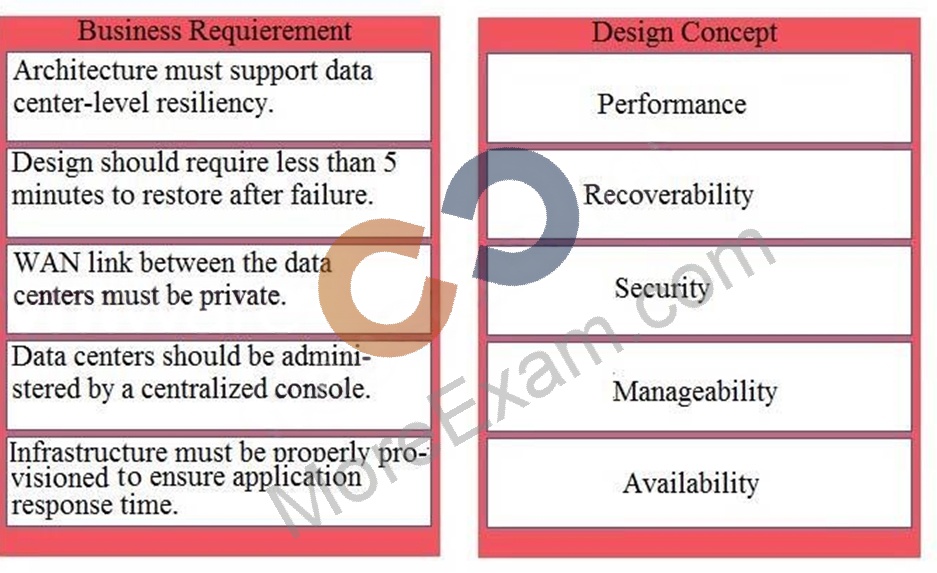
Question5: DRAG DROPMatch the business statement to its appropriate concept.Select and Place:
Question6: A customer wants to make its data available with a RPO of 10 minutes. Replication to the second data center will be done using the network. Which type of storage configuration should be used?
Question7: DRAG DROPA company is a leading for an online travel booking system with over a $1,000,000 turnover each day. The company wants to leverage VMware cloud solutions to consolidate, scale, and ensure high availability for all of its data centers.Match each business requirement to its appropriate design concept.Select and Place:
Question8: A company is designing a new vSphere cluster to support a mission-critical application.The application requires 100% availability and cannot be restarted to recover from an ESXi host failure.The application consists of a group of 16 virtual machines, each with 8 vCPU configured.Which solution satisfies the availability requirements?
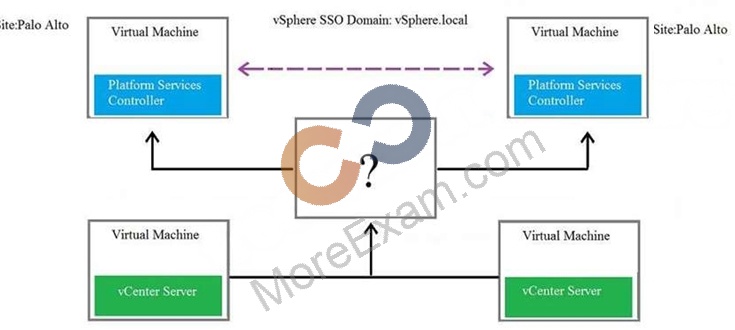
Question9: The customer has two sites that must operate independently of each other in the event of a WAN failure.During normal operations, administrators from each site must be able to manage the other site through the vSphere Web Client.Which vCenter Server Appliance (VCSA) and Platform Services Controller (PSC) diagram shows the VMware-recommended design that satisfies these requirements?A:B:C:D:
Question10: A company would like to leverage snapshot technology on vSphere 6.5.Which configuration supports taking snapshots?
Question11: A customer has requested a vSphere 6.5 deployment design where ESXi hosts are provisioned with Auto Deploy. The customer requires that certificates can be automatically refreshed and renewed from the vSphere Web Client for ESXi hosts.Which certificate policy should be configured for vCenter Server?
Question12: View the exhibit.Referring to the exhibit, which appliance or device belongs in the square with the question mark?
Question13: After the vSAN iSCSI Target service is enabled, which statement about iSCSI networks is true?
Question14: A company is conducting a technology refresh and has requested assistance with a vSphere 6.5 design.The company has a corporate headquarters and two data centers strategically placed around thecountry, which provide the bulk of the computer power and storage for their customer-facing stores.The company requires each of its stores to be able to operate independently if connectivity is ever lost.Presently, all stores are configured differently and must be standardized as part of the technologyrefresh.To support store operations, only a dozen applications are required.Any downtime during store hours could result in significant losses.Any proposed design must minimize cost.What is a VMware-recommended option for this scenario?
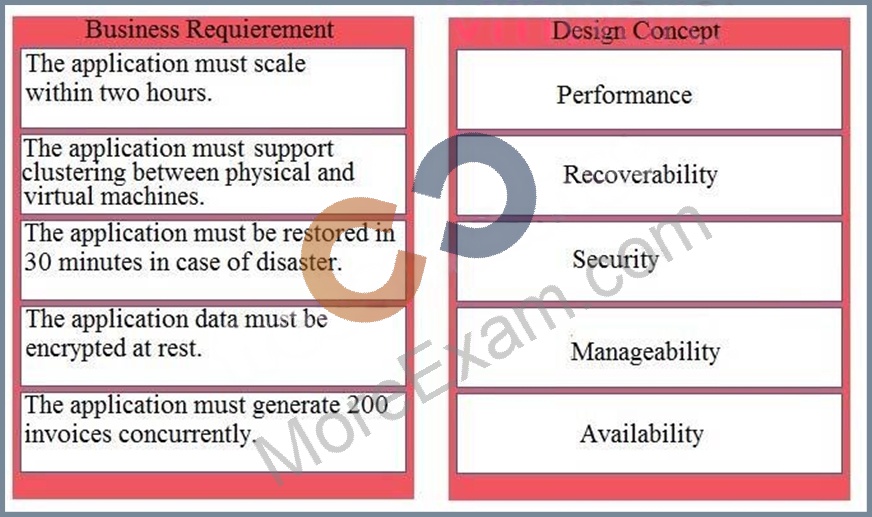
Question15: DRAG DROPA leading steel manufacturer relies on SAP for purchase, sales, and invoice processing.It is planning to virtualize its servers to reduce CAPEX and OPEX.However, its CIO is concerned about the availability, performance, manageability, recoverability, andsecurity for the SAP database and ERP instance.Match the business requirement with the appropriate design concept.Select and Place:
Question16: The hardware operations team is planning to purchase new ESXi hosts for the upcoming budget year and is requesting recommendations on the type of servers to purchase for a web application. The web application consists of hundreds of small virtual machines (1 vCPU and 8GB of RAM) that are members of a software cluster.The solution should have these abilities:Recover from ESXi host hardware failuresZero downtime for a limited number of critical virtual machines (VMs)Migrate running VMs between ESXi hosts without interruption to the operating systemPerform these functions using VMware ESXi servers, vCenter Server, and high-speed networkinterfacesWhat are the three functional requirements and their associated VMware technologies? (Choose three.)
Question17: DRAG DROPA company has one data center site running 50 hosts and 400 virtual machines and requires a vSphere 6.x design.1. The CIO wants to add a secondary site for Disaster Recovery (DR) with 4 hours RPO.2. The application developer is concerned about anticipated growth as several new project begin.3. The CISO is worried about data leaks and theft.4. The CTO would like to buy new servers with better specifications and higher consolidation ratio.Determine the critical requirements for each of the key stakeholders. Some requirements might have more than one stakeholder.Select and Place:
Question18: An architect is designing a vSphere 6.5 implementation.The customer requires Cross vCenter vMotion for the newly-created data centers in New York andHoustonEach data center will use different IP networks for management and vMotionWhen creating a vMotion network, which two statements are required in order to use Cross vCenter Server vMotion? (Choose two.)
Question19: A virtualization administrator has been tasked with migrating several business applications from physical to virtual. The administrator must also migrate the virtual machines from VMware Workstation to vSphere 6.5, using vCenter Converter Standalone 6.1.In this scenario, which two source types are supported? (Choose two.)
Question20: A customer has these requirements for storage:Protocol used must have a file based access.Protocol used must have built in native multipathing.Protocol used must support authentication.To meet these requirements, which protocol should be used for storage?
Question21: A company provides critical financial and statistical data for several major banks:The company ensures that the bank's customer data is secure and that analytics data is available whenneeded.Customers rely on this data before making crucial business and financial decisions.Just a few minutes of downtime can result in loss of revenue and trust.To meet high-availability requirements, the company's IT infrastructure components must be redundant.The company established three data centers across the global and interconnected them with high-speed WAN links.Due to the rapid growth of its customers and their increasing demands, the compute, network, andstorage were procured and managed by the company's enterprise system administrators group.What are its two key challenges? (Choose two.)
Question22: A customer is using a vSphere APIs for Storage Awareness (VASA) compatible storage array. The VASA provider is published as a virtual appliance.To ensure recoverability, where must the VASA provider and vCenter server virtual machines be stored?
Question23: A company is consolidating its IT operations efforts by moving the Finance, IT, and QA departments towards a self-service environment, following SDDC best practices.All departments have different priorities and expectations for uptime of the required infrastructure andapplicationsProject stakeholders are still discussing final approvals for the budget with the CFO.To drive down the operating cost of the environment, only blade servers will implement this project.To ensure business continuity, a colocation provider was chosen to fail over virtual machines.The implementation of the project will follow a public reference architecture provided by VMware.What is the assumption in this scenario?
Question24: A company is implementing a new cluster to support its end user desktop workloads.The workload is required to support 200 virtual machines.Each end-user desktop is configured with two vCPUs, 8GB or RAM, and 40GB of thick-provisioned diskspace.The architect has expressed concerns that virtual machine swap files will fill the 8.5TB datastoreavailable to the cluster.Which two strategies would address the architect's concern? (Choose two.)
Question25: A customer has storage arrays from two different storage vendors at two different sites. The customer wants to restore operations at the secondary site in the event of a disaster.Which VMware technology must be used to meet this requirement?
Question26: A solution architect has been tasked with designing a new environment for a company's growing needs, and has obtained this information:Uptime is critical during regular business hours when 95% of the transactions occur. Application uptimemust be 99.9% during those hours.In a true disaster, the business can withstand a day of data loss and half a day of downtime.The company is one year into a 5-year contact with the co-lo data center.The building that is currently occupied no longer has any floor space available, but the company has 3empty racks of space. The co-lo can provide up to 11KVA of power per rack.There are current contains with Dell to provide servers and with Cisco to provide the networkcomponentsThe network team has standardized on an end-to-end 10Gb network.Based on this information, what are two requirements for the new design? (Choose two.)
Question27: A developer is tasked with building an application to process shipping requests. The developer is consulting the vSphere team to determine failover options and performance best practices.The development team is providing three physical ESXi hosts with 8 CPU cores and 256GB of RAMper host.The developer does NOT know how many virtual machines they will require.Which virtual machine (VM) sizing strategy will provide the highest level of uptime, individual VM performance, and failover capacity?
Question28: A company's CTO is very concerned about web server outages that are caused by server hardware failures.Which feature can protect the web server virtual machine from this kind of outage?
Question29: A customer is deploying a mission-critical Oracle database with high SLA requirements, including high performance and high availability. The customer has chosen to purchase an All-Flash vSAN solution.Which three storage policies should be used? (Choose three.)
Question30: A customer is virtualizing a mission-critical Microsoft SQL database and needs a configuration that provides optimal NUMA performance.There are two possible clusters that the database virtual machine could reside in Cluster A is vSphere6.0 and Cluster B is vSphere 6.5.All ESXi hosts contain dual Intel Xeon E5-2650 processors (ie:2 socket, 10 cores per socket) and256Gb RAM with vNUMA in its default configuration.Given this scenario, which three statements are true? (Choose three.)
Question31: A company has requested a new vSphere 6.5 design that will allow it to finally break the 80 virtualization barrier by virtualizing its resource-intensive application.The application is highly available by design and includes application-aware clustering softwarecapable of operating as a fully distributed system.The company's Application Version 2.0 consists of 386 small applications and middleware with non-persistent storage and 24 database virtual machines at each data center.When coupled with a proper load balancing solution, this application can continue operating even withthe loss of an entire data center, but the small applications and middleware tiers within a data center must exist within the same broadcast domain.The database tier is tightly controlled with a firewall policy that only allows middleware tier access, andis replicated to other sites using a dedicated circuit.Which two application requirements apply to this scenario? (Choose two.)
Question32: A solution architect has been tasked with designing a new environment that meets the needs of a growing company, and has obtained this information.The current capacity will be exhausted in 180 days, and the new infrastructure must be deployed and inproduction prior to that.The new servers have a 90-day delivery time.A data center for disaster recovery has been selected, and it is 20 miles away and connected by MPLS.The security team will continue to utilize its current investments and VM Encryption for the newenvironment.The backup team currently uses Data Domain, and reports show an 8:1 compression and deduplicationration for backups.Based on the information obtained, which two statements are risks for the new design? (Choose two.)
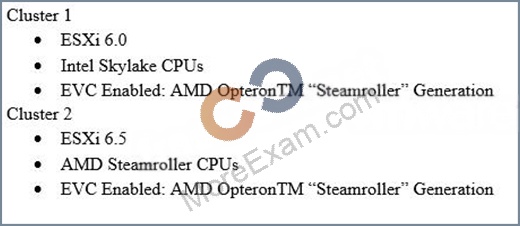
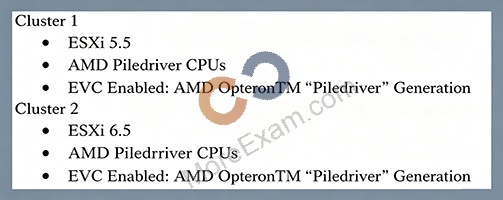
Question33: The ability to live-migrate all virtual machines between two clusters is a requirement in the customer's design. Which two clusters and EVC configurations will accomplish this? (Choose two.) A:B:C:D:
Question34: A company has requested assistance with a new cross-site failover design to support business-critical applications.It has two sites which are very well-connected, and latency is less than 5ms round trip.The customer requires that its applications be restarted even in the event of a total site failure.The applications must be kept online even when migrated during maintenance.Storage arrays at either site support both synchronous and asynchronous replication.Which two options are accurate application requirements for this scenario? (Choose two.)